
5 Types of Digital Front Doors
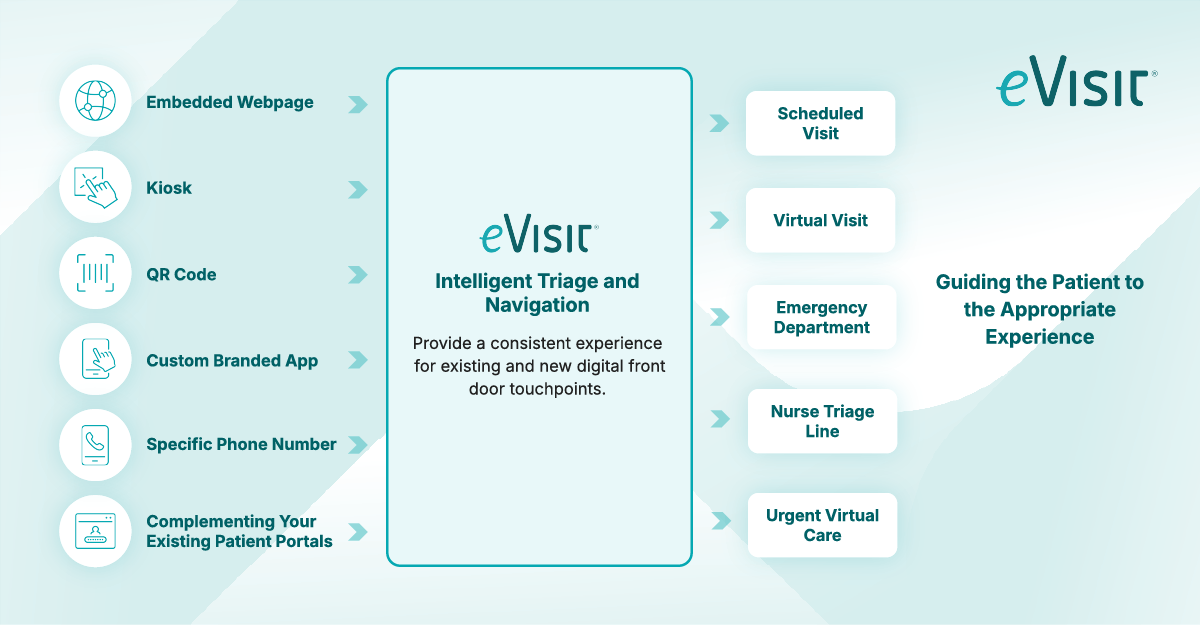
Digital front doors are here to stay. According to the 2024 ASTP Health IT Data Brief, nearly all hospitals allow patients to view and download health information electronically, 92% of hospitals enable patients to message their provider electronically, and 81% of hospitals provide patient access via apps.
These trends confirm the increasing prevalence and importance of digital front doors in healthcare. Healthcare delivery systems are strategically using multiple entry points to maximize patient access and prevent patient leakage to neighboring systems.
Here are five of the most common types of digital front doors:
Embedded Webpage
An embedded webpage works within the healthcare delivery system’s main site. It links patients via a computer or mobile device to scheduling, symptom checkers, virtual visit entry, and “quick action” navigation tools, among other features.
These services integrate with scheduling engines and, where needed, leverage SMART on FHIR for clinical data. AI chatbots and 24/7 guidance are essential for ease of patient use and optimization. These digital front doors are relatively low-cost compared to those that require physical equipment.
Kiosk
Kiosks are among the best-known digital front doors because they use large physical stations located near a facility’s entrance. Kiosks use touchscreens and specialized software, paired with barcode scanners, printers, and optional payment modules. Ideally, the software can be configured to meet an organization’s needs.
EHR scheduling and check-in services need to connect with Kiosks via a secure MRN lookup system. Kiosks must be easily visible for patients to find, but also private enough so patients feel comfortable entering sensitive information. Kiosks can be enhanced by integrating them with other digital front doors, such as backup QR codes.
QR Code
QR Codes are well-known to the public because they are used across all industries. They can generate a secure, time-limited code that redirects a patient to a prebuilt intake form, app, or site. Codes can be easily created using various software services, and staff can be trained to connect URLs.
QR tokens can be linked to a patient’s MRN to ensure identity. Organizations need to ensure their mobile pages are optimized for QR codes and that no large file uploads are required when using this type of digital front door.
Custom Branded App
Custom-branded apps are becoming more popular because they are flexible enough to meet the needs of a healthcare delivery system. Apps can handle scheduling, messaging, virtual visits, reminders, forms, and even home monitoring. These tools are conveniently accessible on any smart device and can be designed to comply with HIPAA requirements for storing personal health information.
To ensure apps work more efficiently, they can be equipped with push notifications through secure gateways. Embedded data feeds can also make it easier for clinician dashboards to stay up to date and properly connected to whatever device the patient is using. Apps are also useful for testing pilot projects and metrics thanks to their adaptability.
Specific Phone Number
Phone numbers may not seem very “digital,” but they can be an essential digital front door when paired with the right technology. A dedicated number can be routed to a call center or virtual care platform. A platform can use data integration to surface patient records directly to agents. This enables virtual triage and routes patients to the appropriate level of care.
Patients can use self-service options such as appointments and refill requests without speaking to a human agent. This option will continue to improve as AI advances. Patients can access help 24/7 and even request a callback if they do not wish to wait on hold.
Complementing Existing Patient Portals
Technology is evolving rapidly, with new digital front doors continually emerging. While adopting these varied entry points—from Kiosks to custom-branded apps—is necessary for broad patient access, they often create a disjointed experience for the patient and a fragmented workflow for providers. This siloed approach creates point-to-point fragmentation, where systems don’t communicate, turning a simple entrance into a digital maze. The challenge and opportunity lie in ensuring every digital touchpoint leads to a cohesive, personalized patient journey.
This is where an intelligent, integrated platform becomes essential for connecting the digital front door ecosystem. For example, eVisit provides the crucial infrastructure to enable and manage various digital entry points, ensuring all these systems talk to each other seamlessly. This includes supporting patient entry via Custom Branded Apps and specialized methods like the QR codes used by customers, such as NYC Health + Hospitals. The eVisit platform ensures the patient journey isn’t a broken loop. Furthermore, eVisit is built on modern interoperability standards, leveraging protocols like SMART on FHIR where applicable, ensuring that scheduling and clinical data flows securely and efficiently between the various digital front doors and the EHR.
Moving beyond a variety of fragmented solutions to create a seamless experience is how modern healthcare delivery systems will truly compete, scale, and deliver the highest quality of care.
Interested in how eVisit can help you transform your varied digital entry points into one intelligent, integrated, and seamless Digital Front Door strategy that optimizes patient triage and throughput? Fill out our form to schedule a consultation with the eVisit team. We look forward to hearing from you!
RESOURCE CENTER
Related Resources