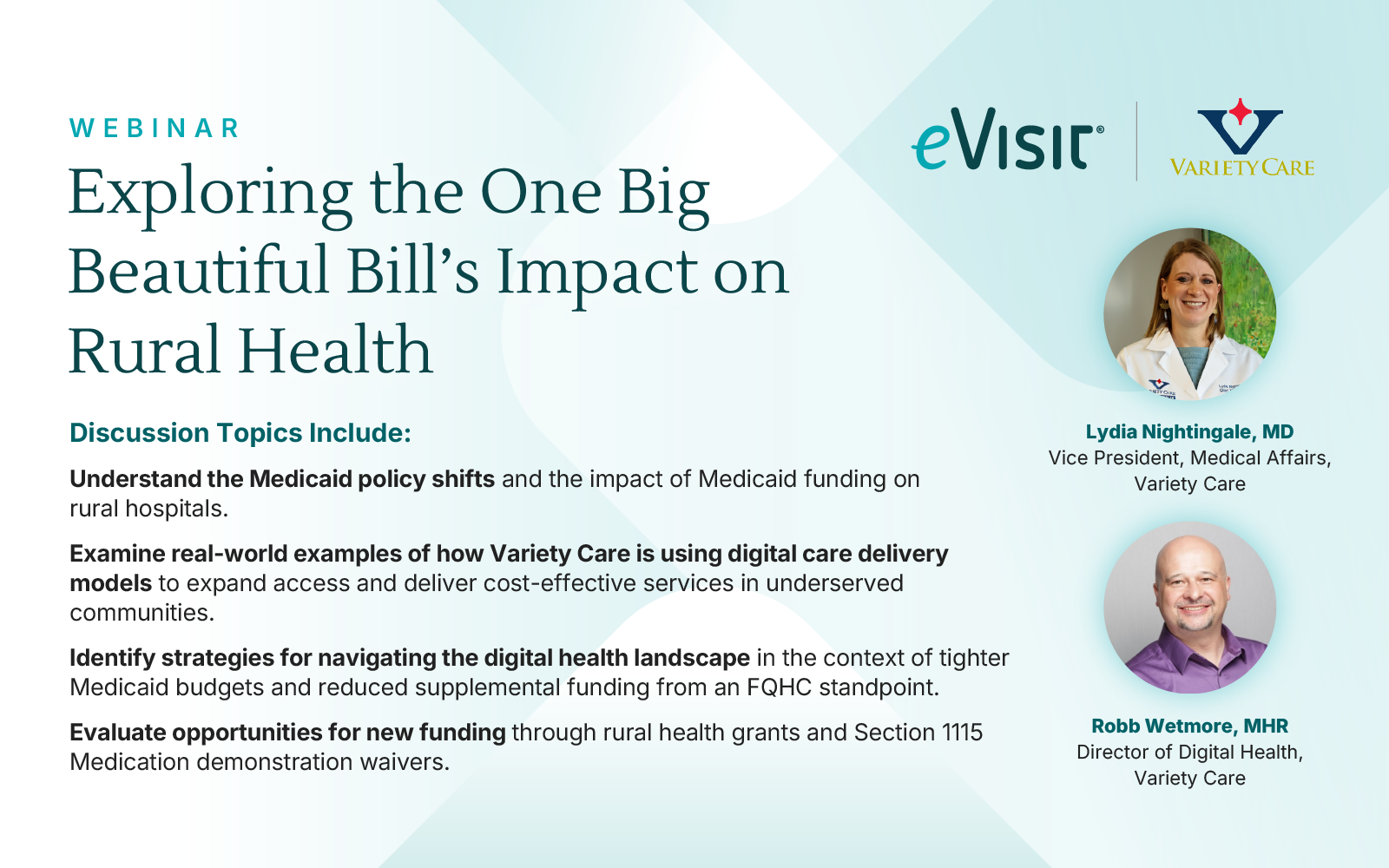
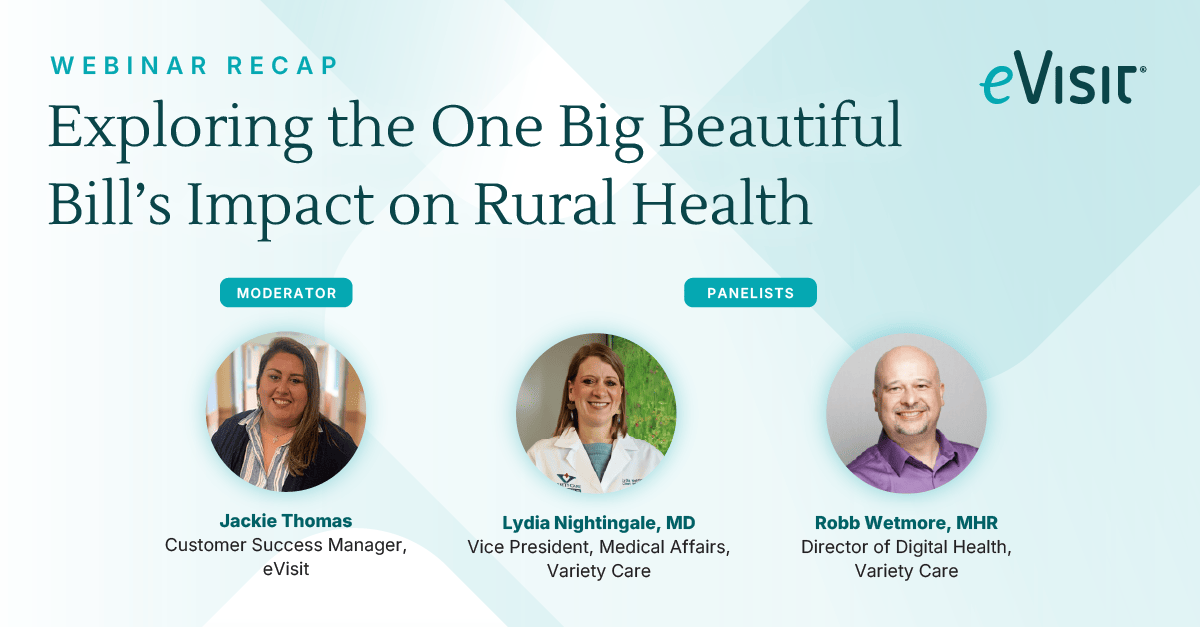
Webinar Recap: Exploring the One Big Beautiful Bill’s Impact on Rural Health
The One Big Beautiful Bill Act (OBBBA), signed July 4th, 2025, will have far-reaching effects on healthcare across the country.
It is estimated that:
- Over 12 million individuals could lose health coverage by 2034.
- This lost coverage will primarily impact Medicaid recipients and may lead to over one trillion dollars in healthcare cuts over the next decade, placing millions of jobs at risk.
- Access to rural healthcare will be particularly impacted
- The OBBBA will lead to a 21% decline in Medicaid reimbursement to certain facilities—further straining organizations that provide vital services for rural patients.
However, during a recent webinar hosted by eVisit, leaders from Variety Care—the largest Federally Qualified Health Center (FQHC) in Oklahoma—shared how they are successfully navigating this environment.
By making a strong commitment to digital care adoption, Variety Care is not just surviving these new realities but thriving. Their strategy ensures that patients in rural communities continue to receive consistent, high-quality care, despite the changing operational pressures.
Medicaid Policy and Rural Hospital Sustainability
Lydia Nightingale, MD, Senior Vice President of Clinical Affairs/Chief Primary Care Officer at Variety Care, understands how shifts in Medicaid funding policies impact the financial stability and service capacities of rural hospitals.
Dr. Nightingale discussed how Variety Care partners with eVisit to improve rural healthcare access. She commented that in the past, Variety Care was not utilizing its digital health technology to the fullest extent. With the help of eVisit, Variety Care has enhanced its ability to triage patients and quickly screen them for treatment virtually.
What started as a pilot program has led to several benefits:
- Approximately 20 additional patients seen per day across the organization.
- Improved patient and provider satisfaction.
- Decreased utilization of the Emergency Department (ED)
Increasing Rural Healthcare Access
In the past, a rural patient might have unnecessarily driven an hour to the closest ED to be seen by a provider. Now, patients can connect with a virtual specialist from the comfort of their own home. This directly translates to increased value-based care and scalability. Increasing value in the shadow of the OBBBA is paramount for any health system’s future success and overall efficiency.
Dr. Nightingale also discussed how rural facilities are collaborating with CMS to deliver improved care. One program that she is excited about is the Transforming Maternal Health (TMaH) Model. This care delivery program aims to improve maternal health outcomes for people covered by Medicaid and CHIP through three main pillars:
- Access to Care, Infrastructure, and Workforce Capacity
- Quality Improvement and Safety
- Whole-Person Care Delivery
The backbone to all three of these pillars is digital care adoption. Dr. Nightingale views TMaH as an example of how innovative models can utilize virtual care to stretch dollars while providing superior care services.
Rural health facilities are also developing strategies to ensure scalability over the next decade. Scaling a program needs to be a two-pronged approach:
- Ensuring that reimbursement and financial needs adapt to changes in Medicaid enrollments.
- Facilitating efficiency within pre-existing workflows to improve the care process for both providers and patients.
Implementing Digital Care Technology
Robb Wetmore, MHR, Director of Digital Healthcare at Variety Care, shared how Variety Care is partnering with eVisit to implement digital health tools that foster this two-pronged approach of scalability. Robb Wetmore commented that this implementation process “has to be easy in order to be successful.”
A few examples of this process include:
- Increasing access to virtual visits, no matter a patient’s location.
- Integrating ambient scribe technology into existing EHR systems allows providers to spend more time talking with patients face-to-face.
- Allowing patients to easily access virtual interpreters and freeing up bilingual staff to perform more in-person care.
A key example of these tools can be seen in Variety Care’s use of the Rural Health Care Program (RHCP), which will receive $50 billion in funding between 2026 and 2030. While the RHCP continues to subsidize broadband and telecommunication costs for rural providers, new federal initiatives under the bill are helping health centers expand access through virtual care, digital tools, and workforce support.
Variety Care utilizes eVisit’s integrated software suite to bridge these gaps and enhance access. Robb Wetmore explained that the process for a patient to see a provider virtually is quite sustainable while simultaneously being easy to implement. A patient doesn’t need to download an app, but simply clicks a link 15 minutes before their appointment.
“It’s only a couple of clicks for our patients and it’s only a couple of clicks for our care teams.”
– Robb Wetmore, MHR, Director of Digital Healthcare at Variety Care
Implementing New Technology
Virtual visits are also being paired with ambient scribe technologies to ensure Variety Care is adjusting to evolving government documentation requirements. “The ambient scribe technologies that we’re currently looking into will not only listen to the conversation between the patient and provider but will also surface diagnoses,” Robb Wetmore explained.
Implementing digital health tools is difficult but imperative, given the shifting landscape created by the OBBBA. The OBBBA reshapes Medicaid, shrinks safety nets, and redefines the role of digital care in rural America. eVisit and Variety Care are working to ensure that their facilities have the necessary tools to reach patients who may be affected by changes in funding.
The OBBBA reshapes Medicaid, shrinks safety nets, and redefines digital care’s role in rural America. Healthcare delivery systems must adjust fast. By integrating eVisit’s seamless, scalable platform, Variety Care has established a strategic blueprint for success. They prove that with the right technology and the right partner, health systems can do more than just survive legislative uncertainty—they can actively expand access, enhance patient outcomes, and secure a robust financial future for their providers and the communities they serve.
To hear more from Dr. Nightingale and Robb Wetmore, you can access the full webinar here or view the Variety Care case study.
RESOURCE CENTER
Related Resources