The Digital Front Door’s Blind Spot: Why the ‘App Gap’ is Costing Health Systems Patients

Healthcare has spent the last decade advancing the “Digital Front Door.” The vision is straightforward: a patient feels a symptom, opens a branded app, and schedules a visit. On paper, it’s the ultimate convenience.
But there is a growing realization among health system leaders that this “app-first” strategy has a massive blind spot. What happens when patients simply don’t want to use an app or a portal? Or worse, what about the millions in rural America where high-speed internet is still inconsistent? For the nearly 22% of seniors who don’t own a smartphone, a mandatory app isn’t an entry point—it’s a major barrier to care.
As it turns out, this isn’t a small “niche” group. It’s a decent portion of the American population. Failing to build for them doesn’t just hurt your patient satisfaction scores, it creates massive “leakage” where patients fall out of your system entirely.
The Reality of the Digital Divide
We often assume everyone has a late-model smart phone with 5G speeds. The data tells a different story:
- Connectivity Hurdles: As many as 50% of rural Americans lack access to reliable broadband. Even when high-speed internet is technically available, approximately one-third of Americans do not subscribe to it.
- Portal Fatigue: While portal adoption is rising, 65% of patients still find coordinating care through these platforms to be overwhelming and time-consuming.
- The Preference Gap: Despite the push for digital-only tools, recent 2025 data shows that 72.7% of patients still prefer phone calls when communicating with their healthcare providers.
The Phone Call: The Ultimate Low-Tech, High-Value Entry Point
If you want to solve for “Front End Access,” you have to meet patients where they are. For many, that is a standard phone call.
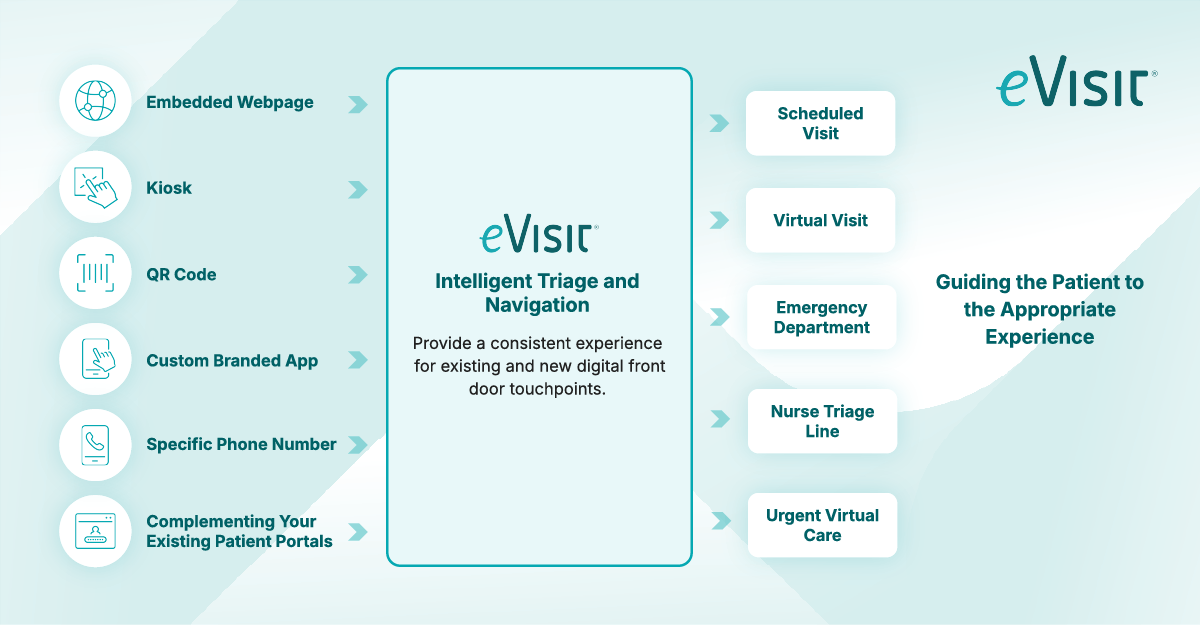
The market is shifting toward Telephony-Driven Access, but this isn’t a return to traditional, unrecorded phone calls. Instead, platforms like eVisit Connect are transforming the standard phone call into a high-value entry point for a coordinated digital care pathway.
Rather than relying on “point solutions” or standalone dialers that create data silos, eVisit Connect integrates directly into the existing EHR via SMART on FHIR. This ensures that every interaction—even a low-tech audio call—is captured as a trackable enterprise event. By meeting patients where they are, health systems can maintain professional boundaries through number masking, seamlessly escalate audio calls to video when necessary, and ensure that rural or senior patients don’t fall through the cracks of a digital-only strategy.
Orchestration: Short-Term Access vs. Long-Term Value
Building for the “non-app” audience isn’t just about being inclusive; it’s about Care Orchestration.
Short-Term (The “Front Door”): You solve the immediate access problem. A patient calls in, they are seen, and they don’t have to struggle with a login or password reset.
Long-Term (The “Pathway”): This is where the real value lies. Once that call happens, the system shouldn’t let the patient go. An orchestrated experience ensures that the call is connected to scheduling, follow-ups, and specialty consultations across the health system.
RHTP and the Future of Rural Health Infrastructure
This gap is becoming increasingly critical as states navigate the Rural Health Transformation Program (RHTP). With federal funding now prioritized for modernizing rural health infrastructure, the mandate is clear: states must build for the future without abandoning the people they serve today. True digital care transformation isn’t about replacing familiar channels like the phone; it’s about upgrading them. By meeting patients where they are—using the tools they already have and trust—health systems can create a sustainable path toward long-term digital adoption while ensuring no one is left behind in the process.
Building for Everyone
The goal of a modern patient access strategy isn’t to choose between digital-first tools and traditional communication. The goal is to build a unified infrastructure that accommodates the reality of every patient’s circumstances.
A truly enterprise-grade solution allows a provider to meet every patient where they are, even if that means a simple audio call, and then, if the clinical situation requires it, instantly escalating to a video visit or bringing in a remote interpreter.
Hospitals can no longer afford to let the “App Gap” dictate who receives timely care. By prioritizing access through familiar, reliable channels like the phone, health systems can reduce friction, capture more patients, and ensure that digital transformation actually includes everyone.
RESOURCE CENTER
Related Resources